1. The EdCafe I participated in was definitely a new experience. It was a very different method of learning that I have never experienced before. I enjoyed this new experience as it made the idea of public speaking a group discussion a lot less scary and a lot more manageable. I think to enhance the EdCafe next time, maybe groups that are located near the SmartBoard and whiteboard can utilize it better. I was never an attendee at these areas, but what I saw was that some groups were not using them. However, another think I liked about the EdCafe was the small groups of discussion. With a larger group, I definitely feel like its harder to get your voice heard and it is also a little more nerve wracking. I found it easier to talk and discuss with people in smaller groups rather than the larger groups we are all accustomed to. Finally, one other thing that could be improved is to equal out the number of people in each group. I know the entire point of the EdCafe is to choose where you want to go, but I felt bad for the groups that only had one attendee. Maybe the students could be divided a little more evenly the next time we do this.
2. During the EdCafe, I was surprised to find out that I enjoyed leading as much as I did. It was very fun to lead a discussion and ask all the questions that you specifically want answered. As a leader, I found I could easily direct the conversation into productive and thought provoking directions. Also, working with a partner to lead took the stress off and made it more relaxed and enjoyable. Even though there is only supposed to be one leader, I feel that we should stick with the partner leaders to reduce stress and keep the conversations flowing. The only thing I regret as being a leader is that I didn't get through all of my questions. Unfortunately, time was tight so we had to move along quickly. I wish I could have had more time to get through the rest of my questions and continue the lively discussions that were going on.
3. As a attendee, I felt as though my voice was finally getting heard. In the Socrative Seminar bigger groups, it's much harder to find a right time to speak that truly gets your opinion on the table. I felt as though I was able to contribute a lot more as a speaker unlike my silent performances in Socrative Seminars. I feel as though notes being taken were easy to take and everybody paused at once to take some notes. This made me feel less nervous that I would miss something important like in a Socrative Seminar. Another thing that made attending worthwhile was thinking of a takeaway. I personally was able to reflect on the discussions we had and pick out the most important things to truly appreciate the discussion. Even though I enjoyed leading more, I feel as though I was able to learn a lot more through attending this EdCafe rather than a Socrative Seminar.
Friday, February 28, 2014

Thursday, February 6, 2014
Northern Attitude Blog Post
If I were a Historian, then people would need to know this important information as soon as possible. Contrary to some people's beliefs, the people in the North were not as opposed to slavery on moral and economic ground as people thought.
For example, the Lowell Mills were extremely dependent on slavery because they needed it so they could get cotton to make clothing. It's actually funny because the clothing that the Lowell Mills made were actually used by slave owners used it to cloth their slaves. The cotton made a complete circle through the economy of America. The Lowell Mills wanted slaves because they were their main source of business and gave them the most amount of money. The Industrial economy in the North heavily relied on the slave economy in the South.
Also, people in the North held anti-abolitionist meetings in which they opposed the abolition of slavery. These people were not against slavery at all and on a moral standard they wanted slavery to keep going. Also, they didn't truly understand the daily violence that was involved in slavery. They didn't understand that slavery itself was violent and immoral.
Also, according to a documentary clip we watched, over 10,000 slaves were brought into the country through the North. This fact is even more shocking when you realize that Thomas Jefferson knew this was going on but did nothing about it due to the fact that the family that was doing this supported his political campaign. This shows that the North was definitely not against slavery because even the president would allow this to happen.
This information is important to understand so that people don't think the North was completely innocent in this ordeal. The North was clearly not against slavery on moral and definitely not on economic grounds.
Friday, December 27, 2013
Reformer's Post
They had been chained day and night to their bedsteads, and kept in a state so filthy that it was sickening to go near them. — They were usually restrained by the strait‐waistcoat, and with collars round their necks, the collars being fastened with chains or straps to the upper part of the bedstead, to prevent, it was said their tearing their clothes. The feet were fastened with iron leg‐locks and chains.
The men patients were chiefly employed in cultivating the farm, working the garden, improving the grounds constructing fences, cutting wood. and attending to stock. The women were engaged in sewing, knitting, spinning, and assisting in various departments of house‐work, and other occupations and recreations suited to their sex.
(Indentation) Dix Lynde Dorothea "Memorial Soliciting a State Hospital for the
Protection and Cure of the Insane" University of North Carolina Chapel Hill. Novermber 1848. University of North Carolina Chapel Hill. http://www.learnnc.org/lp/editions/nchist‐newnation/4748. (December 23rd, 2013)
Dorothea Dix's purpose in producing this article was to improve the conditions for the mentally insane in the prisons they were being thrown into. Dix was appalled at the treatment of the mentally insane and sought to change it. This source is very believable because it comes straight from Dix herself and you know that what's in the source are things Dix actually said.
During this time period, the mentally insane were thrown into prisons just like they were criminals. They were also given horrible living conditions just like regular criminals. This document helps to paint the picture about just how bad life was for these mentally ill people. The brutal details provided by Dix really make the reader pity the people that went through this. This document does help to paint a full picture because Dix was a firsthand witness to the mistreatment of these people.
Dix's position in this article is clear, she wants better conditions for the mentally ill people she feels are being mistreated. Dix uses details that are scary and vivid to try and convince the reader that they should be behind some sort of prison reform. You can tell by the serious tone she uses that she feels strongly about her opinion and wants others to see what she sees and feel how she feels.
Tuesday, November 26, 2013
Andrew Jackson Post

This political cartoon shows the conflict of Andrew Jackson using the veto more than any other president before him. This use of the veto that was the right of the president was frowned upon in the early 19th century. Jackson was the first president to veto things because of political reasons. The first 6 presidents of the United States vetoed a total of 10 bills during their presidency. The reason this conflict arose was because of Jackson's choice to use the veto 12 times in his 8 years of presidency. However, 7 out of these 12 vetoes were called pocket vetoes which meant he never actually officially vetoed it. Instead he would let the document just die on his desk and not act on it at all.
This political cartoonist believes that Jackson abused his powers. He shows this by calling Jackson "King Andrew the First" and also had him in kings rode and having a staff. This cartoonist obviously believed that Jackson was acting like more of a monarch rather than being democratic like many people claim he was.
However, my personal opinion is that Jackson does deserve his democratic reputation. I don't understand why the cartoonist feels like Jackson is being a monarch, he is simply using a power that comes with the title of the president of the United States. If the president does not agree with a bill, it is his right to veto it. If that's what the president's opinion on the matter is, he should be allowed to do. And the people of the US can't get mad because they elected the president with the opinion he has, so they should be supportive of his veto decisions.
Saturday, November 23, 2013
American Democracy Improves, But It Takes Some Time.
In the 19th century, America was able to overtime become more democratic. In early 19th century, America was barely democratic at all, but they were able to slowly fit the definition of Democracy better and become a better Democratic nation. Democracy is defined as government by the people; a form of government in which the supreme power is vested in the people and exercised directly by them or by their elected agents under a free electoral system. In early 19th century, America was anything but Democratic. For example, there were many requirements that people needed to meet in order to vote, including property and tax paying requirements. This meant that the majority of voters were wealthy and therefore the middle and lower classes didn't have much say in the government. 
However, this graph shows that over time, as more states joined the union, the number of requirements to vote decreased, meaning more people were able to vote and have their voices heard in the government.
Another problem with America in the early 19th century was that people weren't even getting to vote at all. 
This graph shows that in early 19th century, the people had 0 say in who was elected as a presidential elector. Luckily, overtime, America was able to give more power to the people in almost every state, making America as a country more democratic.
Wednesday, November 20, 2013
Romanticism Blog Post

Sunday, November 17, 2013
Revolutions of 1830 and 1848 Post
The revolutions of 1830 and 1848 were failures like many historians thought they were. One example of a revolution that failed was the Russian revolution of 1825. The liberalist revolutionaries wanted a constitutional reform of their conservative government. This revolution was a failure because Nicholas I and the Russian government completely crushed the revolution and killed almost everybody against them.
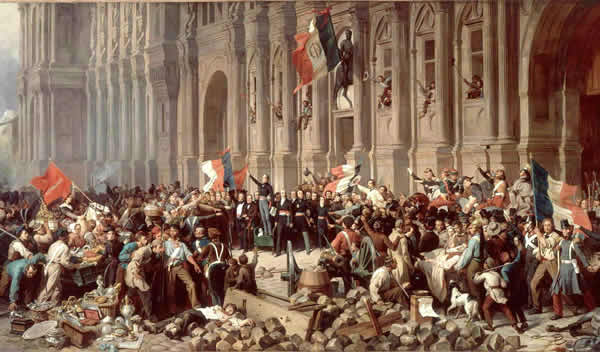
Another example of a failed revolution was the French revolution of 1848. The radical republic wanted to overthrow the current government. Their goals were to get the ruler Louis Phillipe out of power and bring somebody else in to help make new policies. This revolution was also a failure because they were able to get Louis Phillipe out of power, but the new ruler that came in essentially kept the exact same policies as before.
Finally, another example of a failed revolution was the Frankfurt assembly of 1848. German liberal nationalists wanted a constitution written to unite all of the German states into one unified country. The assembly offered a constitution to Frederick IV to rule a united Germany, but he rejected it. This revolution was a failure because the reform they were looking for only lasted one year and then hundreds of people were killed or imprisoned, and the rest fled Germany taking the last of the revolutionary ideas with them.
Frankfurt Assembly Project:
| http://www.educreations.com/lesson/view/frankfurt-assembly/13391311/?s=LJixx0&ref=app |
Subscribe to:
Posts (Atom)