Friday, May 30, 2014

Forced to Change

My topic is the Native Americans and America's westward expansion. It is also about how this westward expansion effected the Native Americans already living in these territories. I chose this topic because I thought that it was very interesting. I previously did not know that Native Americans were living where America was expanding so I wanted to learn more about that. I also wanted to explore any potential conflict that aroused because of this expansion and whether or not it has real world impact today. Overall, I thought this topic would be perfect for the theme of People, Places, and Power.
 
Key Terms:
 
Expansion- the act or process of expanding
Pacific Railway Acts- a series of acts of Congress that promoted the construction of the transcontinental railroad in the United States through authorizing the issuance of government bonds and the grants of land to railroad companies
Homestead Act- several United States federal laws that gave an applicant ownership of land, typically called a "homestead", at little or no cost
Sitting Bull- a Hunkpapa Lakota holy man who led his people as a tribal chief during years of resistance to United States government policies
Reservations- a tract of public land set apart for a special purpose, as for the use of an Indian tribe
Ghost Dance-  a new religious movement incorporated into numerous Native American belief systems
Massacre- the unnecessary, indiscriminate killing of a large number of human beings or animals, as in barbarous warfare or persecution or for revenge or plunder
George Custer- a United States Army officer and cavalry commander in the American Civil War and the American Indian Wars
Dawes Act- adopted by Congress in 1887, authorized the President of the United States to survey American Indian tribal land and divide it into allotments for individual Indians
Assimilation- to take in and incorporate as one's own
Allotment- to divide or distribute by share or portion
Indian Reorganization Act- U.S. federal legislation that secured certain rights to Native Americans (known in law as American Indians or Indians), including Alaska Natives
John Collier - an American social reformer and Native American advocate
Navajos- largest federally recognized tribe of the United States of America with 300,048 enrolled tribal members
 
Enduring Understandings:
 
People in Power abuse those not in Power by manipulating them to do things that only help them.
 
Collier betrayed the Indians trust and it caused them hunger and poverty. (The Indian Question, 230)
 
Allotment had been transforming Indians into landless people. (The Indian Question, 224)
 
People in Power force those not in Power to relocate in order to advance their personal needs.
 
Military abused power by corralling Indians into reservations and shooting them if they ever stepped out. (The Indian Question, 220)
 
Native Americans were put into reservations because they were not "Using their land properly" (The Indian Question, 223)
 
 
So far, my topic relates to People Places and Power because the Indian People were being forced into reservation Places by the People in Power and their are many different conflicts that arose. These themes will definitely develop further as I do more reading and more connecting. So far, it's been a good process reading and relating passages and events to the overall theme.

Wednesday, May 28, 2014

DBQ- Who Killed Reconstruction?

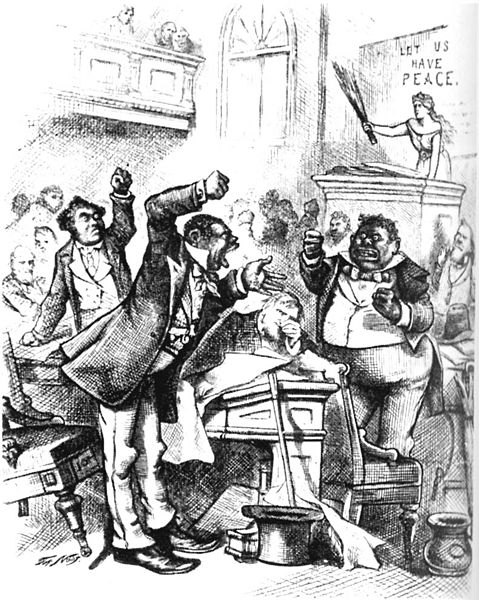
After the Civil War, blacks problems fighting for justice and equality were far from over. This included the 12 years directly after the Civil War, which was called the reconstruction. While there was an increase in freed slaves, there was also a resistance to change, coming mainly from the South. Then, after 12 years, the reconstruction ended. This was due to many things, including violence and threats from the South and overall neglect from the North. While both sides contributed to the death of reconstruction, the combination of violence and threats in the South made them the main culprit. 

First, the South killed reconstruction through violence and threats. First, there is a document where a former white soldier is writing to Congress and pleading for their help. He claims that the KKK, a white supremacist group, has killed a white senator who was trying to help blacks obtain their rights. (Doc A). He also claims that anybody who ignores these serious threats are "a coward, a traitor, or a fool"(Doc A). This shows that the South killed reconstruction through acts of violence because the KKK would kill anybody who supported the change in ideas that came with reconstruction. Their violence led to many people being too afraid to step in and help, this causing reconstruction to be killed altogether. While the KKK didn't always kill people, most of the time they would at least threaten them. It was known that the KKK would go to voting booths and threaten blacks who tried to vote so that they would be too afraid to use their rights and vote. They would use violence sometimes along with these threats by pointing guns at black's heads. (Doc B). This shows that the south killed reconstruction through the KKK's constant threats so that the blacks were not able to vote and use their rights that reconstruction had fought for them to have.  
 
While the South was the majority of the reason why reconstruction was killed, they also had some help from their friends in the North. In the North, they had been growing tired of all of the South's problems and began to disregard them. They started to focus on more national problems including the scandal inside of Grant's government. (Doc C). This shows that the North had a hand in killing reconstruction because they stopped helping the South to focus on problems that they cared about more. The North was also not all supportive of blacks rights. Blacks were called, "unfitted for the proper exercise of political duties." (Doc D). By saying this, it shows that the North didn't feel that blacks were ready for the rights that reconstruction had given them so that played a hand in them helping to kill reconstruction. Blacks were depicted very stereotypically in the North also. In one edition of Harper's Weekly, they are shown being loud and crazy in a political office while whites look on confused and scared. (Doc D). This also proves that that the North helped to kill reconstruction because not all of them supported blacks rights that reconstruction had given them. 


While both sides contributed to the death of reconstruction, the combination of violence and threats in the South made them the main culprit. This was due to the many violence and threats that came from the South during this time. Especially from the KKK, who did not support blacks to have any rights and took action against it. After the Civil War, blacks problems fighting for justice and equality were definitely far from over.


Tuesday, April 29, 2014

Tide Turns Blog Post

During the Civil War, there were points that turned the tides in the favor of the North. One of these points was the battle of Gettysburg. This battle was considered a turning point for many reasons. One reason this was a turning point is because of the high number of casualties for both sides. While you might think that this would be even for both sides, the North had more men to replace the casualties. This meant that casualties had less of an effect on the North than it did on the South. Another reason it was a turning point is because the Confederates lost all hope because of this defeat. Also, Lee has asked to resign from the army because he feels like he is not doing the best job he can. Finally, this battle is a turning point because Lincoln was able to spark Union moral by claiming that the North was fighting for freedom for everybody. This helped the Union army keep on persevering through the war. 

I don't think that it was acceptable to use total war in these circumstances. This is because total war involves harming the property of citizens in order to gain an advantage in war. This is an okay strategy in some situations as long as innocent civilians are not being harmed. However, in this case some civilians were forced to go live in caves and eat animals in order to survive. These extreme conditions were not fair to civilians who had done nothing wrong. This proves that unless justified, total war is not the right thing to do. 

At the end of the war, there were many different reactions as well. First, Lincoln was very tired and completely worn out. Secondly, Northern soldiers began to celebrate but were then reminded that the people who they defeated are once again their fellow countrymen now and they should respect them. This humbled the Northern soldiers and brought peace between the two sides. The Southern soldiers wanted to honor their leaders for the valiant job they had done in the war and then they were finally relieved of duty. For this, they were able to keep their cows and all of their property. 


Sunday, April 6, 2014

Is Discrimination Ever Acceptable?

The question about whether it's ever acceptable to submit to discrimination is an interesting one. On one hand, people can argue that discrimination is never okay, no matter what one could supposedly gain. On the other hand, people could say that doing anything to advance yourself is okay. I believe that it is okay to submit to some discrimination in order to gain advancement.
 
For example, during the Civil War, union soldiers accepted lower pay in order to be able to fight. In this case, these soldiers didn't care what happened to them, they just wanted to fight for what they believe in. They accepted a little bit of discrimination by taking lower pay, but the advantages they gained was that they were able to fight in the war and fight for what they believed in. In this case, the advantages gained were definitely worth a little discrimination.
 
Also, in the photograph we went over in class, a slave and his master are shown sitting next to each other looking like they are about to go into war. The story from the master's family's perspective was that they set this slave free before they war and he fought alongside his former master and even saved his life at one point. However, this story turned out to be false. This slave was in fact not freed and was still a slave. Since no one knew this side of the story, it is probably that the slave was discriminated against and forced to go along with this false story. However this discrimination led to his eventual freedom. I think again in this case the discrimination was worth it because Silas the slave was able to become a free man by just going along with a simple lie. This shows that some discrimination is acceptable in order to gain advancements.


Monday, March 24, 2014

Women's Sphere of Domesticity

During the Civil War, many some women decided to stay inside their Sphere of Domesticity, but others chose to break free and do things that were outside the normal realm for women. The reason that many women broke out of this sphere is because they wanted to make a difference. For example, Rose O'Neal was a spy for the Confederacy. Being a spy was definitely outside of the realm of normal women actions during this time period. She was also captured by the North and put into jail for 4 months. When she died, she was honored as if she was a war hero.

On the other hand, some women like Alice Chapin decided to stay inside the sphere. When her husband left for the war, Alice was devastated but stayed together. She decided to do charity work for fire victims and involve herself in the temperance movement. Since most of this activity was not outside the Sphere, her work was not as risky as others. Her actions show why some women decided to stay inside the Sphere while others decided to venture outside of it,

http://padlet.com/wall/bblockcivilwarquilt

Monday, March 17, 2014

Battle Scavenger Hunt

The battles scavenger hunt was another new and fun way to present the information we've been learning in class. It's always nice to be able to do something enjoyable that is also different from traditional teaching methods. In this project, 20 different small groups were each assigned a battle. Then, each group had to research their particular battle and put their findings on an open google document. For example, this is my battle google doc, https://docs.google.com/document/d/13gvtJhGFByFnlXpCL-9eDcliaHoidcixgmvq1m4Z5x4/edit.
Then, we had to create a QR sign for our google doc, which is just a little symbol on a piece of paper that, when scanned, brings up the google document on your phone. Then you had to pick a location to put your sign and talk to the groups around you so that they could put your clue at the end of their google doc, and then the fun began! After finishing, the class then came back together and talked about the two essential questions and brainstormed the answers together on Padlet. Here are our classes answers. http://padlet.com/wall/bblockcivilwar http://padlet.com/wall/bblockcivilwar1
 
To figure out who was the ultimate victor in each theater, we must look at specific battles and tally up the totals. It is also important to understand why the side that won won. In the east theater, the confederates won many of the early battles. One reason why they did so was because of superior battle tactics and excecution. However, towards the end of the war the Union started to win some eastern battles because of phenomenal leadership on the battlefield from their generals.  
 
In the Naval battles, the Union were the clear winners. They won these battles again due to superior leadership. They also won because they severely damaged the Confederacy's only ironclad, which was their biggest weapon. The Union's dominant naval army proved to be too much for the Confederates.
 
In the western battles, the Union also came out on top. One big reason for this was again the superior leadership in the North. The Union nearly swept all of these battles except for a few. They also won the majority of these battles because the South failed to execute their battle tactics properly. These miscues came back to haunt them and eventually led to their defeat.  

The Biggest Choice

If I were a teenage male during The Civil War, I would choose self-preservation over joining the army of my choice. While the idea of joining a side and fighting for what you believe in an intriguing one, the risk is not worth the reward. Even though choosing not to fight might result in an outcome you don't enjoy, at least you still have your life. 

Choosing to be a solider is a gigantic risk. There are so many things that can go wrong and so many dangers that could end your life. For example, about 1 out of every 4 people that enlisted in the war died. One reason that so many soldiers died was because of the technology of the oblong MiniĆ© ball, which shattered bones when it hit them. This made procedures for surgeons even more difficult, and many wounded soldiers died before reaching the war infirmary. The two options for wounder soldiers were not pretty. The two options were amputation or resection.

First, resection was an extremely painful process. It involved cutting open the limb, sawing out the damaged bone, and then closing the incision. This procedure requires extreme skill from the surgeon and some war surgeons became proficient at this procedure. However, there were may risks involved. For example, there was a big risk of profuse bleeding and infection. Next, there was the option of amputation. This process was fairly simple, you made a cut around the damage limb, and sawed the bone off while removing blood vessels and nerves. For this process, bleeding out was a big concern because sometimes surgeons could not stop the bleeding. Also, with a big open wound, infection was often a sidetrack when amputation had been done. Another reason for many soldiers deaths was the misuse of chloroform. It was used to knock out a patient, but many times the patient would receive too much and would end up dying. These challenges were ones that were tough to overcome for surgeons and ended up causing many deaths to injured soldiers. 

Overall, joining the war was too much of a risk for a teenage boy during this time. With the advanced weaponry, one hit was basically signing your death warrant. With the odds of survival stacked against you, injury had to be avoided which was nearly impossible. For that reason, if I was a teenage boy during this time, I would choose self-preservation over joining the war. 

Image Link: http://graphics8.nytimes.com/images/2012/04/03/science/03CIVI_SPAN/03CIVI-articleLarge.jpg