Creating this videolicious was definitely a struggle, but making it for sure enhanced my understanding of the overall topic. When analyzing the pictures and deciding which enduring understanding they belonged to made me really think about the topic and how it connected to the overall theme. The ordering process was helpful in understanding how the pictures fell into place regarding the enduring understandings. My only wish is that videolicious had been easier to use and there weren't as many restrictions on the time limit and picture limit.
Sunday, June 15, 2014
Forced to Change #3
Working with a group was the best thing possible that could've happened at this stage in the investigation of our topic. After reviewing all the material, it was perfect to collaborate our ideas with others and gain even more of an understanding of our topic. For example, Craig's enduring understanding of "People at the bottom of power structures have no input on how they are controlled." Was very influential in how I understand the topic now. Also, I was able to discuss the pictures with Craig while making the videolicious and we were both able to try and understand them better. Also, while making the video essay with Craig I was able to link the pictures to all of the enduring understandings our group created. This and the creation of our background slides made me understand the topic much more and the theme much more.

Thursday, June 5, 2014
Forced to Change #2
For the past week, I've been looking at an interactive activity that has furthered my understanding on my topic. The link for this activity http://reta.nmsu.edu/modules/longwalk/lesson/maps/lw_map.htm. For this activity, I went through each different part of the activity and did what it asked me to do and looked at the graphs and images that it asked me to. By looking at these graphs and images, I was able to come to a deeper understanding on the struggles that the Navajo Indians went through during this time. I was also able to relate their struggles to the overall theme of this assignment which is People, Places, and Power. These connections I made helped me to understand more of the key terms and make one more Enduring Understanding.
Key Terms:
Key Terms:
Expansion- the act or process of expanding
Pacific Railway Acts- a series of acts of Congress that promoted the construction of the transcontinental railroad in the United States through authorizing the issuance of government bonds and the grants of land to railroad companies
Homestead Act- several United States federal laws that gave an applicant ownership of land, typically called a "homestead", at little or no cost
Sitting Bull- a Hunkpapa Lakota holy man who led his people as a tribal chief during years of resistance to United States government policies
Reservations- a tract of public land set apart for a special purpose, as for the use of an Indian tribe
Ghost Dance- a new religious movement incorporated into numerous Native American belief systems
Massacre- the unnecessary, indiscriminate killing of a large number of human beings or animals, as in barbarous warfare or persecution or for revenge or plunder
George Custer- a United States Army officer and cavalry commander in the American Civil War and the American Indian Wars
Dawes Act- adopted by Congress in 1887, authorized the President of the United States to survey American Indian tribal land and divide it into allotments for individual Indians
Assimilation- to take in and incorporate as one's own
Allotment- to divide or distribute by share or portion
Indian Reorganization Act- U.S. federal legislation that secured certain rights to Native Americans (known in law as American Indians or Indians), including Alaska Natives
John Collier - an American social reformer and Native American advocate
Navajos- largest federally recognized tribe of the United States of America with 300,048 enrolled tribal members
Bosque Redondo- a 40-square-mile (100 km2) area where over 9,000 Navajo and Mescalero Apaches were forced to live
Fort Sumner- a military fort in De Baca County in southeastern New Mexico charged with the internment of Navajo and Mescalero Apache populations from 1863-1868
Bosque Redondo- a 40-square-mile (100 km2) area where over 9,000 Navajo and Mescalero Apaches were forced to live
Fort Sumner- a military fort in De Baca County in southeastern New Mexico charged with the internment of Navajo and Mescalero Apache populations from 1863-1868
Enduring Understandings:
People in Power abuse those not in Power by manipulating them to do things that only help them.
Collier betrayed the Indians trust and it caused them hunger and poverty. (The Indian Question, 230)
Allotment had been transforming Indians into landless people. (The Indian Question, 224)
People in Power force those not in Power to relocate in order to advance their personal needs.
Military abused power by corralling Indians into reservations and shooting them if they ever stepped out. (The Indian Question, 220)
Native Americans were put into reservations because they were not "Using their land properly" (The Indian Question, 223)
People not in Power endured harsh conditions traveling to Places forced upon them by People in Power
Some of them had to travel more than 450 miles by foot, and many died along the way from cold, starvation, or murder. (The Long Walk, Part 1)
Experiencing this event as a Navajo Indian would be extremely devastating. The emotional and physical toll they had to endure was insane. For example, they had to travel over 450 miles on foot, to reach a place that none of them even wanted to go to in the first place. As shown by this map, the route was not exactly the most efficient and looks like it goes through very rough terrain.

People not in Power endured harsh conditions traveling to Places forced upon them by People in Power
Some of them had to travel more than 450 miles by foot, and many died along the way from cold, starvation, or murder. (The Long Walk, Part 1)
Experiencing this event as a Navajo Indian would be extremely devastating. The emotional and physical toll they had to endure was insane. For example, they had to travel over 450 miles on foot, to reach a place that none of them even wanted to go to in the first place. As shown by this map, the route was not exactly the most efficient and looks like it goes through very rough terrain.
This walk was brutal in every way, with supplies running short and death inevitable. Having the risk of death hanging over everybody you love along with yourself would be devastating and almost unbearable. It's safe to say that this journey was one that would rather have not been taken.
Friday, May 30, 2014
Forced to Change
My topic is the Native Americans and America's westward expansion. It is also about how this westward expansion effected the Native Americans already living in these territories. I chose this topic because I thought that it was very interesting. I previously did not know that Native Americans were living where America was expanding so I wanted to learn more about that. I also wanted to explore any potential conflict that aroused because of this expansion and whether or not it has real world impact today. Overall, I thought this topic would be perfect for the theme of People, Places, and Power.
Key Terms:
Expansion- the act or process of expanding
Pacific Railway Acts- a series of acts of Congress that promoted the construction of the transcontinental railroad in the United States through authorizing the issuance of government bonds and the grants of land to railroad companies
Homestead Act- several United States federal laws that gave an applicant ownership of land, typically called a "homestead", at little or no cost
Sitting Bull- a Hunkpapa Lakota holy man who led his people as a tribal chief during years of resistance to United States government policies
Reservations- a tract of public land set apart for a special purpose, as for the use of an Indian tribe
Ghost Dance- a new religious movement incorporated into numerous Native American belief systems
Massacre- the unnecessary, indiscriminate killing of a large number of human beings or animals, as in barbarous warfare or persecution or for revenge or plunder
George Custer- a United States Army officer and cavalry commander in the American Civil War and the American Indian Wars
Dawes Act- adopted by Congress in 1887, authorized the President of the United States to survey American Indian tribal land and divide it into allotments for individual Indians
Assimilation- to take in and incorporate as one's own
Allotment- to divide or distribute by share or portion
Indian Reorganization Act- U.S. federal legislation that secured certain rights to Native Americans (known in law as American Indians or Indians), including Alaska Natives
John Collier - an American social reformer and Native American advocate
Navajos- largest federally recognized tribe of the United States of America with 300,048 enrolled tribal members
Enduring Understandings:
People in Power abuse those not in Power by manipulating them to do things that only help them.
Collier betrayed the Indians trust and it caused them hunger and poverty. (The Indian Question, 230)
Allotment had been transforming Indians into landless people. (The Indian Question, 224)
People in Power force those not in Power to relocate in order to advance their personal needs.
Military abused power by corralling Indians into reservations and shooting them if they ever stepped out. (The Indian Question, 220)
Native Americans were put into reservations because they were not "Using their land properly" (The Indian Question, 223)
So far, my topic relates to People Places and Power because the Indian People were being forced into reservation Places by the People in Power and their are many different conflicts that arose. These themes will definitely develop further as I do more reading and more connecting. So far, it's been a good process reading and relating passages and events to the overall theme.
Wednesday, May 28, 2014
DBQ- Who Killed Reconstruction?
After the Civil War, blacks problems fighting for justice and equality were far from over. This included the 12 years directly after the Civil War, which was called the reconstruction. While there was an increase in freed slaves, there was also a resistance to change, coming mainly from the South. Then, after 12 years, the reconstruction ended. This was due to many things, including violence and threats from the South and overall neglect from the North. While both sides contributed to the death of reconstruction, the combination of violence and threats in the South made them the main culprit.
First, the South killed reconstruction through violence and threats. First, there is a document where a former white soldier is writing to Congress and pleading for their help. He claims that the KKK, a white supremacist group, has killed a white senator who was trying to help blacks obtain their rights. (Doc A). He also claims that anybody who ignores these serious threats are "a coward, a traitor, or a fool"(Doc A). This shows that the South killed reconstruction through acts of violence because the KKK would kill anybody who supported the change in ideas that came with reconstruction. Their violence led to many people being too afraid to step in and help, this causing reconstruction to be killed altogether. While the KKK didn't always kill people, most of the time they would at least threaten them. It was known that the KKK would go to voting booths and threaten blacks who tried to vote so that they would be too afraid to use their rights and vote. They would use violence sometimes along with these threats by pointing guns at black's heads. (Doc B). This shows that the south killed reconstruction through the KKK's constant threats so that the blacks were not able to vote and use their rights that reconstruction had fought for them to have.

While the South was the majority of the reason why reconstruction was killed, they also had some help from their friends in the North. In the North, they had been growing tired of all of the South's problems and began to disregard them. They started to focus on more national problems including the scandal inside of Grant's government. (Doc C). This shows that the North had a hand in killing reconstruction because they stopped helping the South to focus on problems that they cared about more. The North was also not all supportive of blacks rights. Blacks were called, "unfitted for the proper exercise of political duties." (Doc D). By saying this, it shows that the North didn't feel that blacks were ready for the rights that reconstruction had given them so that played a hand in them helping to kill reconstruction. Blacks were depicted very stereotypically in the North also. In one edition of Harper's Weekly, they are shown being loud and crazy in a political office while whites look on confused and scared. (Doc D). This also proves that that the North helped to kill reconstruction because not all of them supported blacks rights that reconstruction had given them.

While both sides contributed to the death of reconstruction, the combination of violence and threats in the South made them the main culprit. This was due to the many violence and threats that came from the South during this time. Especially from the KKK, who did not support blacks to have any rights and took action against it. After the Civil War, blacks problems fighting for justice and equality were definitely far from over.
Images:
http://www.hoodedutilitarian.com/wp-content/uploads/2012/09/479px-Colored_rule.jpg
http://www.thenorthstarnews.com/Content/101/white-democrats-nsn110112.jpg
http://www.hoodedutilitarian.com/wp-content/uploads/2012/09/479px-Colored_rule.jpg
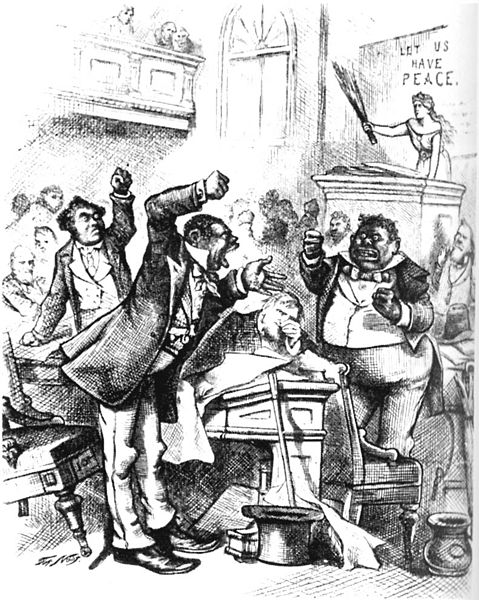
http://www.thenorthstarnews.com/Content/101/white-democrats-nsn110112.jpg


Tuesday, April 29, 2014
Tide Turns Blog Post
During the Civil War, there were points that turned the tides in the favor of the North. One of these points was the battle of Gettysburg. This battle was considered a turning point for many reasons. One reason this was a turning point is because of the high number of casualties for both sides. While you might think that this would be even for both sides, the North had more men to replace the casualties. This meant that casualties had less of an effect on the North than it did on the South. Another reason it was a turning point is because the Confederates lost all hope because of this defeat. Also, Lee has asked to resign from the army because he feels like he is not doing the best job he can. Finally, this battle is a turning point because Lincoln was able to spark Union moral by claiming that the North was fighting for freedom for everybody. This helped the Union army keep on persevering through the war.
I don't think that it was acceptable to use total war in these circumstances. This is because total war involves harming the property of citizens in order to gain an advantage in war. This is an okay strategy in some situations as long as innocent civilians are not being harmed. However, in this case some civilians were forced to go live in caves and eat animals in order to survive. These extreme conditions were not fair to civilians who had done nothing wrong. This proves that unless justified, total war is not the right thing to do.
At the end of the war, there were many different reactions as well. First, Lincoln was very tired and completely worn out. Secondly, Northern soldiers began to celebrate but were then reminded that the people who they defeated are once again their fellow countrymen now and they should respect them. This humbled the Northern soldiers and brought peace between the two sides. The Southern soldiers wanted to honor their leaders for the valiant job they had done in the war and then they were finally relieved of duty. For this, they were able to keep their cows and all of their property.
Sunday, April 6, 2014
Is Discrimination Ever Acceptable?
The question about whether it's ever acceptable to submit to discrimination is an interesting one. On one hand, people can argue that discrimination is never okay, no matter what one could supposedly gain. On the other hand, people could say that doing anything to advance yourself is okay. I believe that it is okay to submit to some discrimination in order to gain advancement.
For example, during the Civil War, union soldiers accepted lower pay in order to be able to fight. In this case, these soldiers didn't care what happened to them, they just wanted to fight for what they believe in. They accepted a little bit of discrimination by taking lower pay, but the advantages they gained was that they were able to fight in the war and fight for what they believed in. In this case, the advantages gained were definitely worth a little discrimination.
Also, in the photograph we went over in class, a slave and his master are shown sitting next to each other looking like they are about to go into war. The story from the master's family's perspective was that they set this slave free before they war and he fought alongside his former master and even saved his life at one point. However, this story turned out to be false. This slave was in fact not freed and was still a slave. Since no one knew this side of the story, it is probably that the slave was discriminated against and forced to go along with this false story. However this discrimination led to his eventual freedom. I think again in this case the discrimination was worth it because Silas the slave was able to become a free man by just going along with a simple lie. This shows that some discrimination is acceptable in order to gain advancements.


Monday, March 24, 2014
Women's Sphere of Domesticity
During the Civil War, many some women decided to stay inside their Sphere of Domesticity, but others chose to break free and do things that were outside the normal realm for women. The reason that many women broke out of this sphere is because they wanted to make a difference. For example, Rose O'Neal was a spy for the Confederacy. Being a spy was definitely outside of the realm of normal women actions during this time period. She was also captured by the North and put into jail for 4 months. When she died, she was honored as if she was a war hero.
On the other hand, some women like Alice Chapin decided to stay inside the sphere. When her husband left for the war, Alice was devastated but stayed together. She decided to do charity work for fire victims and involve herself in the temperance movement. Since most of this activity was not outside the Sphere, her work was not as risky as others. Her actions show why some women decided to stay inside the Sphere while others decided to venture outside of it,
http://padlet.com/wall/bblockcivilwarquilt
Monday, March 17, 2014
Battle Scavenger Hunt
The battles scavenger hunt was another new and fun way to present the information we've been learning in class. It's always nice to be able to do something enjoyable that is also different from traditional teaching methods. In this project, 20 different small groups were each assigned a battle. Then, each group had to research their particular battle and put their findings on an open google document. For example, this is my battle google doc, https://docs.google.com/document/d/13gvtJhGFByFnlXpCL-9eDcliaHoidcixgmvq1m4Z5x4/edit.
Then, we had to create a QR sign for our google doc, which is just a little symbol on a piece of paper that, when scanned, brings up the google document on your phone. Then you had to pick a location to put your sign and talk to the groups around you so that they could put your clue at the end of their google doc, and then the fun began! After finishing, the class then came back together and talked about the two essential questions and brainstormed the answers together on Padlet. Here are our classes answers. http://padlet.com/wall/bblockcivilwar http://padlet.com/wall/bblockcivilwar1
To figure out who was the ultimate victor in each theater, we must look at specific battles and tally up the totals. It is also important to understand why the side that won won. In the east theater, the confederates won many of the early battles. One reason why they did so was because of superior battle tactics and excecution. However, towards the end of the war the Union started to win some eastern battles because of phenomenal leadership on the battlefield from their generals.
In the Naval battles, the Union were the clear winners. They won these battles again due to superior leadership. They also won because they severely damaged the Confederacy's only ironclad, which was their biggest weapon. The Union's dominant naval army proved to be too much for the Confederates.
In the western battles, the Union also came out on top. One big reason for this was again the superior leadership in the North. The Union nearly swept all of these battles except for a few. They also won the majority of these battles because the South failed to execute their battle tactics properly. These miscues came back to haunt them and eventually led to their defeat.
The Biggest Choice
If I were a teenage male during The Civil War, I would choose self-preservation over joining the army of my choice. While the idea of joining a side and fighting for what you believe in an intriguing one, the risk is not worth the reward. Even though choosing not to fight might result in an outcome you don't enjoy, at least you still have your life.
Choosing to be a solider is a gigantic risk. There are so many things that can go wrong and so many dangers that could end your life. For example, about 1 out of every 4 people that enlisted in the war died. One reason that so many soldiers died was because of the technology of the oblong Minié ball, which shattered bones when it hit them. This made procedures for surgeons even more difficult, and many wounded soldiers died before reaching the war infirmary. The two options for wounder soldiers were not pretty. The two options were amputation or resection.
First, resection was an extremely painful process. It involved cutting open the limb, sawing out the damaged bone, and then closing the incision. This procedure requires extreme skill from the surgeon and some war surgeons became proficient at this procedure. However, there were may risks involved. For example, there was a big risk of profuse bleeding and infection. Next, there was the option of amputation. This process was fairly simple, you made a cut around the damage limb, and sawed the bone off while removing blood vessels and nerves. For this process, bleeding out was a big concern because sometimes surgeons could not stop the bleeding. Also, with a big open wound, infection was often a sidetrack when amputation had been done. Another reason for many soldiers deaths was the misuse of chloroform. It was used to knock out a patient, but many times the patient would receive too much and would end up dying. These challenges were ones that were tough to overcome for surgeons and ended up causing many deaths to injured soldiers.
Overall, joining the war was too much of a risk for a teenage boy during this time. With the advanced weaponry, one hit was basically signing your death warrant. With the odds of survival stacked against you, injury had to be avoided which was nearly impossible. For that reason, if I was a teenage boy during this time, I would choose self-preservation over joining the war.

Image Link: http://graphics8.nytimes.com/images/2012/04/03/science/03CIVI_SPAN/03CIVI-articleLarge.jpg
Monday, March 10, 2014
Infogram Blog Post
Making an infogram is another new and fun way to present the information I've learned. The creation of an infograph was a fun but challenging this to do because it really tested our ability to realize which information is the most important to use and present it in a visually effective way. The reason why I chose the topics I did for my graphs is because I think the are the topics that best help to answer the essential question. When studying a war like this, we needed to figure out what makes both sides successful and how it effects their strategy in the way. I think things such as population, transportation, and economic value are keys components to winning a war. In order to win a war, you need to have people, which is why I chose to show population. Also, transportation such as railroads are important because it allows for easier access around the country in which you are fighting. Also, the value of manufactured goods are important because in order to fund a war you need lots of money which rests partly on the value of manufactured goods.
In my infograph, I decided to make 4 different charts that were all visually appealing. That was a viewed could easily pick out the important information and not get bored doing it. I also kept a consistent color to represent the North and the South so that it would again be easier for the reader to see the point I was trying to make. The interesting theme and pattern also improved the overall look to the infograph and hopefully made a interesting and helpful learning tool.
Link to my infograph: https://infogr.am/resources-in-1860-north-vs-south?src=web
Tuesday, March 4, 2014
Project Post
This semester, the class did a research project. This project explored some of the causes of the Civil war. To present these projects, we were given an assignment to make a "scrapbook" in which we used pictures and captions to help explore the theme of conflict and compromise. We also included an introduction essay to make sure the reader had a brief knowledge before being shown our sources. This project was a fun way to show our learning and to present the information in a fun and informative way!
Link to my project on secession of the south: http://southsecedes.weebly.com
Picture of timeline which shows all groups project topics: 
Friday, February 28, 2014
EdCafe Reflection
1. The EdCafe I participated in was definitely a new experience. It was a very different method of learning that I have never experienced before. I enjoyed this new experience as it made the idea of public speaking a group discussion a lot less scary and a lot more manageable. I think to enhance the EdCafe next time, maybe groups that are located near the SmartBoard and whiteboard can utilize it better. I was never an attendee at these areas, but what I saw was that some groups were not using them. However, another think I liked about the EdCafe was the small groups of discussion. With a larger group, I definitely feel like its harder to get your voice heard and it is also a little more nerve wracking. I found it easier to talk and discuss with people in smaller groups rather than the larger groups we are all accustomed to. Finally, one other thing that could be improved is to equal out the number of people in each group. I know the entire point of the EdCafe is to choose where you want to go, but I felt bad for the groups that only had one attendee. Maybe the students could be divided a little more evenly the next time we do this.
2. During the EdCafe, I was surprised to find out that I enjoyed leading as much as I did. It was very fun to lead a discussion and ask all the questions that you specifically want answered. As a leader, I found I could easily direct the conversation into productive and thought provoking directions. Also, working with a partner to lead took the stress off and made it more relaxed and enjoyable. Even though there is only supposed to be one leader, I feel that we should stick with the partner leaders to reduce stress and keep the conversations flowing. The only thing I regret as being a leader is that I didn't get through all of my questions. Unfortunately, time was tight so we had to move along quickly. I wish I could have had more time to get through the rest of my questions and continue the lively discussions that were going on.
3. As a attendee, I felt as though my voice was finally getting heard. In the Socrative Seminar bigger groups, it's much harder to find a right time to speak that truly gets your opinion on the table. I felt as though I was able to contribute a lot more as a speaker unlike my silent performances in Socrative Seminars. I feel as though notes being taken were easy to take and everybody paused at once to take some notes. This made me feel less nervous that I would miss something important like in a Socrative Seminar. Another thing that made attending worthwhile was thinking of a takeaway. I personally was able to reflect on the discussions we had and pick out the most important things to truly appreciate the discussion. Even though I enjoyed leading more, I feel as though I was able to learn a lot more through attending this EdCafe rather than a Socrative Seminar.
2. During the EdCafe, I was surprised to find out that I enjoyed leading as much as I did. It was very fun to lead a discussion and ask all the questions that you specifically want answered. As a leader, I found I could easily direct the conversation into productive and thought provoking directions. Also, working with a partner to lead took the stress off and made it more relaxed and enjoyable. Even though there is only supposed to be one leader, I feel that we should stick with the partner leaders to reduce stress and keep the conversations flowing. The only thing I regret as being a leader is that I didn't get through all of my questions. Unfortunately, time was tight so we had to move along quickly. I wish I could have had more time to get through the rest of my questions and continue the lively discussions that were going on.
3. As a attendee, I felt as though my voice was finally getting heard. In the Socrative Seminar bigger groups, it's much harder to find a right time to speak that truly gets your opinion on the table. I felt as though I was able to contribute a lot more as a speaker unlike my silent performances in Socrative Seminars. I feel as though notes being taken were easy to take and everybody paused at once to take some notes. This made me feel less nervous that I would miss something important like in a Socrative Seminar. Another thing that made attending worthwhile was thinking of a takeaway. I personally was able to reflect on the discussions we had and pick out the most important things to truly appreciate the discussion. Even though I enjoyed leading more, I feel as though I was able to learn a lot more through attending this EdCafe rather than a Socrative Seminar.
Thursday, February 6, 2014
Northern Attitude Blog Post
If I were a Historian, then people would need to know this important information as soon as possible. Contrary to some people's beliefs, the people in the North were not as opposed to slavery on moral and economic ground as people thought.
For example, the Lowell Mills were extremely dependent on slavery because they needed it so they could get cotton to make clothing. It's actually funny because the clothing that the Lowell Mills made were actually used by slave owners used it to cloth their slaves. The cotton made a complete circle through the economy of America. The Lowell Mills wanted slaves because they were their main source of business and gave them the most amount of money. The Industrial economy in the North heavily relied on the slave economy in the South.
Also, people in the North held anti-abolitionist meetings in which they opposed the abolition of slavery. These people were not against slavery at all and on a moral standard they wanted slavery to keep going. Also, they didn't truly understand the daily violence that was involved in slavery. They didn't understand that slavery itself was violent and immoral.
Also, according to a documentary clip we watched, over 10,000 slaves were brought into the country through the North. This fact is even more shocking when you realize that Thomas Jefferson knew this was going on but did nothing about it due to the fact that the family that was doing this supported his political campaign. This shows that the North was definitely not against slavery because even the president would allow this to happen.
This information is important to understand so that people don't think the North was completely innocent in this ordeal. The North was clearly not against slavery on moral and definitely not on economic grounds.
Friday, December 27, 2013
Reformer's Post
They had been chained day and night to their bedsteads, and kept in a state so filthy that it was sickening to go near them. — They were usually restrained by the strait‐waistcoat, and with collars round their necks, the collars being fastened with chains or straps to the upper part of the bedstead, to prevent, it was said their tearing their clothes. The feet were fastened with iron leg‐locks and chains.
The men patients were chiefly employed in cultivating the farm, working the garden, improving the grounds constructing fences, cutting wood. and attending to stock. The women were engaged in sewing, knitting, spinning, and assisting in various departments of house‐work, and other occupations and recreations suited to their sex.
(Indentation) Dix Lynde Dorothea "Memorial Soliciting a State Hospital for the
Protection and Cure of the Insane" University of North Carolina Chapel Hill. Novermber 1848. University of North Carolina Chapel Hill. http://www.learnnc.org/lp/editions/nchist‐newnation/4748. (December 23rd, 2013)
Dorothea Dix's purpose in producing this article was to improve the conditions for the mentally insane in the prisons they were being thrown into. Dix was appalled at the treatment of the mentally insane and sought to change it. This source is very believable because it comes straight from Dix herself and you know that what's in the source are things Dix actually said.
During this time period, the mentally insane were thrown into prisons just like they were criminals. They were also given horrible living conditions just like regular criminals. This document helps to paint the picture about just how bad life was for these mentally ill people. The brutal details provided by Dix really make the reader pity the people that went through this. This document does help to paint a full picture because Dix was a firsthand witness to the mistreatment of these people.
Dix's position in this article is clear, she wants better conditions for the mentally ill people she feels are being mistreated. Dix uses details that are scary and vivid to try and convince the reader that they should be behind some sort of prison reform. You can tell by the serious tone she uses that she feels strongly about her opinion and wants others to see what she sees and feel how she feels.
The men patients were chiefly employed in cultivating the farm, working the garden, improving the grounds constructing fences, cutting wood. and attending to stock. The women were engaged in sewing, knitting, spinning, and assisting in various departments of house‐work, and other occupations and recreations suited to their sex.
(Indentation) Dix Lynde Dorothea "Memorial Soliciting a State Hospital for the
Protection and Cure of the Insane" University of North Carolina Chapel Hill. Novermber 1848. University of North Carolina Chapel Hill. http://www.learnnc.org/lp/editions/nchist‐newnation/4748. (December 23rd, 2013)
Dorothea Dix's purpose in producing this article was to improve the conditions for the mentally insane in the prisons they were being thrown into. Dix was appalled at the treatment of the mentally insane and sought to change it. This source is very believable because it comes straight from Dix herself and you know that what's in the source are things Dix actually said.
During this time period, the mentally insane were thrown into prisons just like they were criminals. They were also given horrible living conditions just like regular criminals. This document helps to paint the picture about just how bad life was for these mentally ill people. The brutal details provided by Dix really make the reader pity the people that went through this. This document does help to paint a full picture because Dix was a firsthand witness to the mistreatment of these people.
Dix's position in this article is clear, she wants better conditions for the mentally ill people she feels are being mistreated. Dix uses details that are scary and vivid to try and convince the reader that they should be behind some sort of prison reform. You can tell by the serious tone she uses that she feels strongly about her opinion and wants others to see what she sees and feel how she feels.
Tuesday, November 26, 2013
Andrew Jackson Post

This political cartoon shows the conflict of Andrew Jackson using the veto more than any other president before him. This use of the veto that was the right of the president was frowned upon in the early 19th century. Jackson was the first president to veto things because of political reasons. The first 6 presidents of the United States vetoed a total of 10 bills during their presidency. The reason this conflict arose was because of Jackson's choice to use the veto 12 times in his 8 years of presidency. However, 7 out of these 12 vetoes were called pocket vetoes which meant he never actually officially vetoed it. Instead he would let the document just die on his desk and not act on it at all.
This political cartoonist believes that Jackson abused his powers. He shows this by calling Jackson "King Andrew the First" and also had him in kings rode and having a staff. This cartoonist obviously believed that Jackson was acting like more of a monarch rather than being democratic like many people claim he was.
However, my personal opinion is that Jackson does deserve his democratic reputation. I don't understand why the cartoonist feels like Jackson is being a monarch, he is simply using a power that comes with the title of the president of the United States. If the president does not agree with a bill, it is his right to veto it. If that's what the president's opinion on the matter is, he should be allowed to do. And the people of the US can't get mad because they elected the president with the opinion he has, so they should be supportive of his veto decisions.
This political cartoonist believes that Jackson abused his powers. He shows this by calling Jackson "King Andrew the First" and also had him in kings rode and having a staff. This cartoonist obviously believed that Jackson was acting like more of a monarch rather than being democratic like many people claim he was.
However, my personal opinion is that Jackson does deserve his democratic reputation. I don't understand why the cartoonist feels like Jackson is being a monarch, he is simply using a power that comes with the title of the president of the United States. If the president does not agree with a bill, it is his right to veto it. If that's what the president's opinion on the matter is, he should be allowed to do. And the people of the US can't get mad because they elected the president with the opinion he has, so they should be supportive of his veto decisions.
Saturday, November 23, 2013
American Democracy Improves, But It Takes Some Time.
In the 19th century, America was able to overtime become more democratic. In early 19th century, America was barely democratic at all, but they were able to slowly fit the definition of Democracy better and become a better Democratic nation. Democracy is defined as government by the people; a form of government in which the supreme power is vested in the people and exercised directly by them or by their elected agents under a free electoral system. In early 19th century, America was anything but Democratic. For example, there were many requirements that people needed to meet in order to vote, including property and tax paying requirements. This meant that the majority of voters were wealthy and therefore the middle and lower classes didn't have much say in the government. 
However, this graph shows that over time, as more states joined the union, the number of requirements to vote decreased, meaning more people were able to vote and have their voices heard in the government.
Another problem with America in the early 19th century was that people weren't even getting to vote at all. 
This graph shows that in early 19th century, the people had 0 say in who was elected as a presidential elector. Luckily, overtime, America was able to give more power to the people in almost every state, making America as a country more democratic.
Wednesday, November 20, 2013
Romanticism Blog Post

Sunday, November 17, 2013
Revolutions of 1830 and 1848 Post
The revolutions of 1830 and 1848 were failures like many historians thought they were. One example of a revolution that failed was the Russian revolution of 1825. The liberalist revolutionaries wanted a constitutional reform of their conservative government. This revolution was a failure because Nicholas I and the Russian government completely crushed the revolution and killed almost everybody against them.
Another example of a failed revolution was the French revolution of 1848. The radical republic wanted to overthrow the current government. Their goals were to get the ruler Louis Phillipe out of power and bring somebody else in to help make new policies. This revolution was also a failure because they were able to get Louis Phillipe out of power, but the new ruler that came in essentially kept the exact same policies as before.

Finally, another example of a failed revolution was the Frankfurt assembly of 1848. German liberal nationalists wanted a constitution written to unite all of the German states into one unified country. The assembly offered a constitution to Frederick IV to rule a united Germany, but he rejected it. This revolution was a failure because the reform they were looking for only lasted one year and then hundreds of people were killed or imprisoned, and the rest fled Germany taking the last of the revolutionary ideas with them.
Frankfurt Assembly Project:
| http://www.educreations.com/lesson/view/frankfurt-assembly/13391311/?s=LJixx0&ref=app |
Friday, November 8, 2013
Selfie Swag Post
The United States reaction to the Quintuple alliance resulted in the creation of the Monroe Doctorine. For example, when Russia came to the northwest coast of the country looking to form colonies, Monroe was not going to let Russia step all over the US. He says, "To the minister of the United States at St. Petersburg to arrange by amicable negotiation the respective rights and interest of the two nations on the northwest coast of this continent." Monroe will arrange a meeting with Russian prime minister but will not just give Russia the land. Another example is when the Quintuple alliance came up with the principle of intervention. Monroe stands up for all of the newly independent nations when he says, "We could not view any interposition for the purpose of oppressing them." Monroe is saying that if anybody tries to retake over the new countries then the US will step in.

My perspective was from the view of a Latin American revolutionary and I would support the Monroe Doctorine because as a newly independent country, we would like the support of another country just incase some big European power tried to come and take us over again.
Tuesday, November 5, 2013
Congress of Vienna Blog Post
One of the many problems the congress of Vienna faced was the problem of who would be in power in France. This problem came up after the French Revolution and France had no real ruler to guide them. The congress came up with the principle of legitimacy, which would restore the lawful monarchs in France but make sure that is wasn't an absolute monarchy like it was before. The reason the congress needed to be careful with who they put in charge was because France had just gone through a revolution, and putting a ruler in power that ruled similarly to the ruler beforehand could spark another unwanted revolution. This solution appeals to Metternich because of his conservative views. The congress was able to restore the throne to the people who had held it before which kept things the same, but minimal changes were needed to keep the peace in France. The impact of this decision made by the congress pleased both sides. It made France a constitutional monarchy, which pleased the citizens of France. It also was able to appeal to Metternich's beliefs because the rulers were able to regain control and it still was still a version of monarchy.


Subscribe to:
Posts (Atom)